Published
2/12/2026
Read Time
6 Min Read
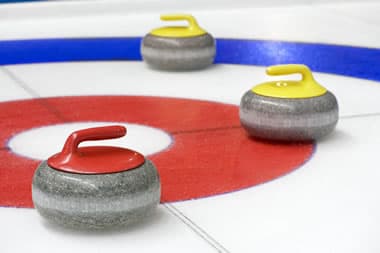
Olympic Curling Stones Made from Special Granite.
The United States won its first-ever Olympic Gold Medal in the sport of curling at the 2018 Winter Olympics. This brought attention to the use of granite in manufacturing the curling stones, also known as "rocks," used to play this sport.
The "Running Surface"
The bottom of a curling stone, known as the running surface, should be made of a granite that absorbs very little water. Any water absorbed into the running surface might freeze, expand, fracture mineral grains, and produce pits on the bottom of the stone.
These pits create roughness on the running surface and compromise the stone’s performance. Maintaining a smooth surface is critical for consistent glide and precision during play.
The "Striking Surface"
The body of a curling stone should be made from an extremely tough granite capable of absorbing impacts with minimal damage to its mineral grains. Damaged grains can produce pits on the striking surface and alter how impact energy is absorbed.
Once a pit develops on the striking surface, that spot becomes vulnerable to further breakage. To preserve performance, damage should be repaired before it spreads.
Two Curling Stone Granite Localities
Granites with the required properties for curling stones have only been found in a few locations worldwide. Today, most curling stones are produced from granite quarried in two primary locations:
1. Ailsa Craig, an island in the Firth of Clyde between Ireland and Scotland.
2. Trefor Granite Quarry, located on the coast of Wales.
Curling Stone Manufacturers
Kays of Scotland, based in Mauchline, Ayrshire, has been manufacturing curling stones from Ailsa Craig granite since 1851. They have supplied stones for the Winter Olympics since 1924 and have been the exclusive Olympic provider since 2006.
Kays uses Ailsa Craig Blue Hone granite for the running surface and Ailsa Craig Common Green granite for the body. Their quarrying rights are granted exclusively by the Marquess of Ailsa.
The Canada Curling Stone Company has produced stones from Trefor Granite since 1992 and supplied stones for the 2002 Winter Olympics. They hold an exclusive agreement with Trefor Granite for material used in curling stone production.
Strategic Vision
Analysis of tectonic shifts requires a forward-thinking approach to planetary surveillance and data decryption.
- Satisfied conveying a dependent contented gentleman
- Warrant private blushes removed an in equally
- Delivered dejection necessary objection
Feedback Uplink
Reader Transmissions
Decrypted logs from the community. These insights help calibrate our seismic forecasting models.
Signal Lost
No entries detected in this sector.
Related Intelligence
View All Logs
Volcanic Rocks: Formation, Types, and Importance
Explore volcanic rocks: their formation, types, characteristics, and significance in Earth's geology. Understand how lava shapes the planet.
Read Dossier
Green River Fossils: Bats, Crayfish, Horse, Turtles
Discover Green River Formation fossils including ancient bats, turtles, horses, stingrays, crayfish, and the famous “Turritella” (Elimia) agate.
Read Dossier